Aisha Rahman
In reviewHandwritten scan, 2 pages · question 3
· 312 words
· marked against 2 school-marked samples
Changes save as you make them
Previous
1 of 7
Next
Question 3. 'Convenience has made us worse at looking after ourselves.' How far do you agree?
The page as it was sent to the AI. Name, class and index areas set up for this assignment are blanked. Your own marks are still drawn on top.
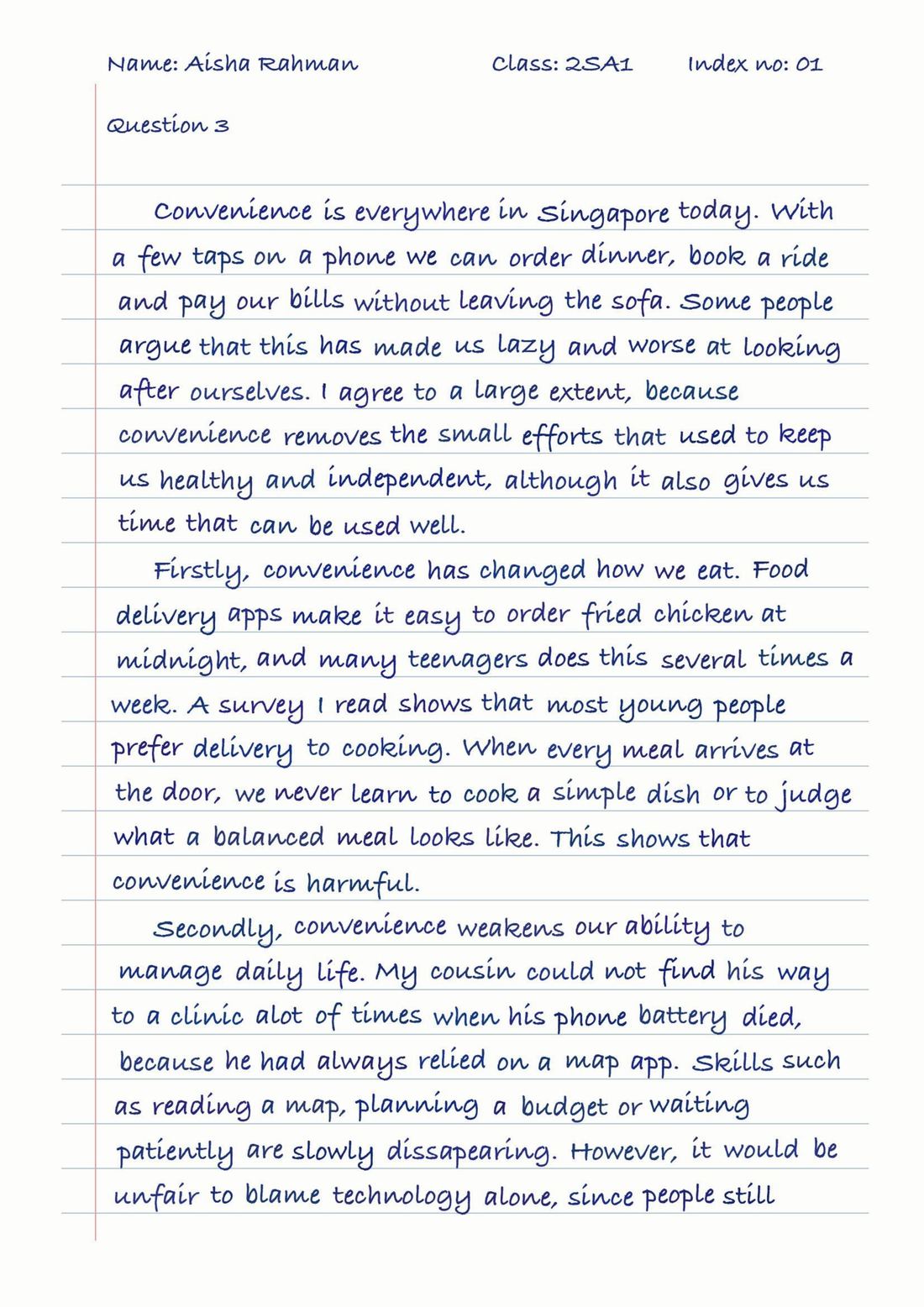
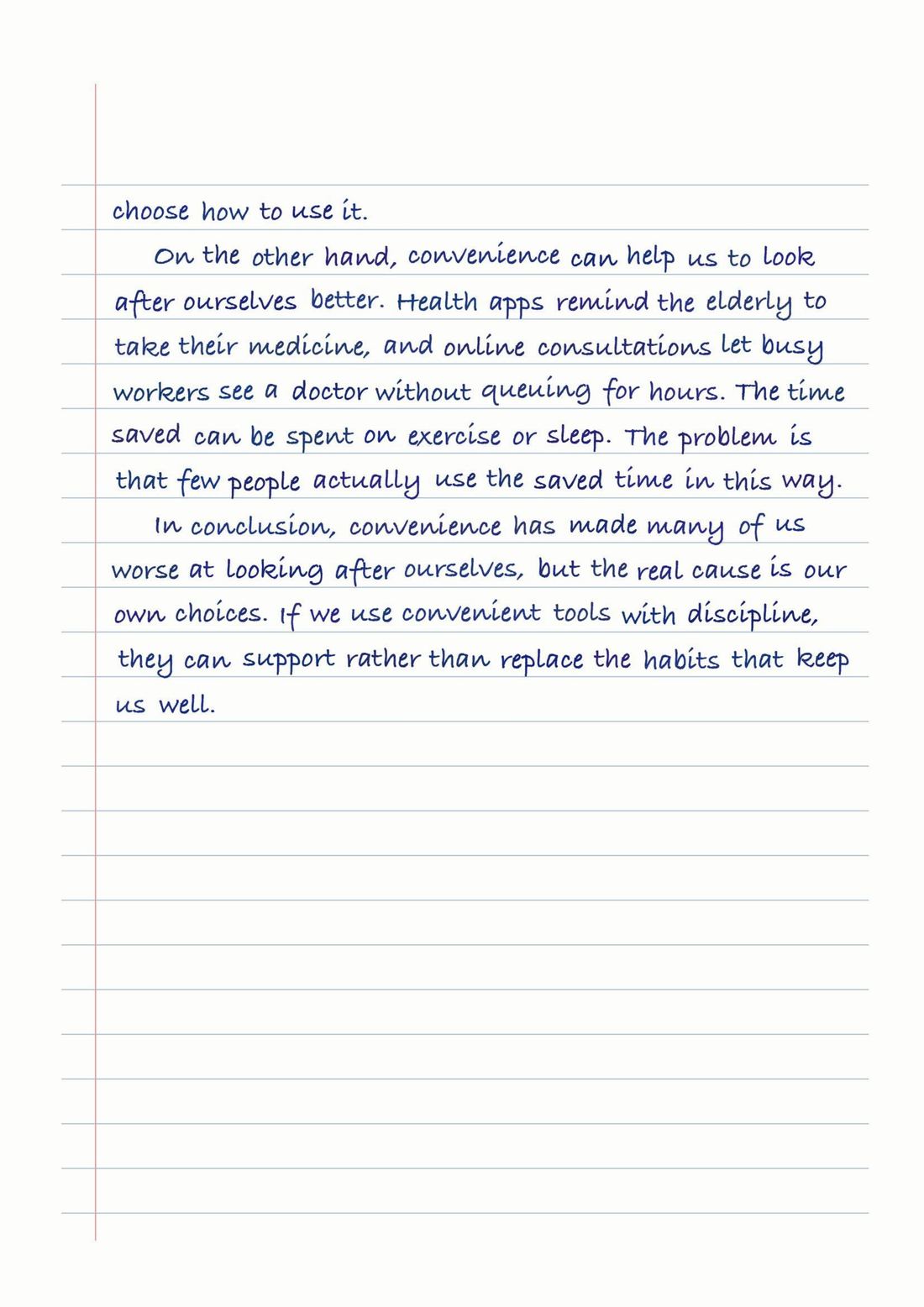
Marking codes. TS = Topic sentence · eg = Example · exp = Explain further · eval = Evaluate · link = Link back to the question · rel = Relevance · e = Expression · g = Grammar · sp = Spelling · p = Punctuation · v = Word choice · ? = Unclear
2 unclear readings in the handwriting.
para 3: "dissapearing"; para 2: "midnight". Check against the scan.
1Convenience is everywhere in Singapore today. With a few taps on a phone we can order dinner, book a ride and pay our bills without leaving the sofa. Some people argue that this has made us lazy and worse at looking after ourselves. I agree to a large extent, because convenience removes the small efforts that used to keep us healthy and independent, although it also gives us time that can be used well.
Sets out the issue and a qualified stand.
2Firstly, convenience has changed how we eat. Food delivery apps make it easy to order fried chicken at midnight, and many teenagers does this several times a week. A survey I read shows that most young people prefer delivery to cooking. When every meal arrives at the door, we never learn to cook a simple dish or to judge what a balanced meal looks like. This shows that convenience is harmful.
A relevant point about diet. The evidence is vague.
3Secondly, convenience weakens our ability to manage daily life. My cousin could not find his way to a clinic alot of times when his phone battery died, because he had always relied on a map app. Skills such as reading a map, planning a budget or waiting patiently are slowly dissapearing. However, it would be unfair to blame technology alone, since people still choose how to use it.
Relies on one anecdote, then starts to evaluate.
4On the other hand, convenience can help us to look after ourselves better. Health apps remind the elderly to take their medicine, and online consultations let busy workers see a doctor without queuing for hours. The time saved can be spent on exercise or sleep. The problem is that few people actually use the saved time in this way.
A real counter-argument with apt examples.
5In conclusion, convenience has made many of us worse at looking after ourselves, but the real cause is our own choices. If we use convenient tools with discipline, they can support rather than replace the habits that keep us well.
Returns to the stand and adds a condition.
Correct the transcription
Content band 19-24
AI draft 19 (band 19-24)
/ 30
Use of English band 13-16
AI draft 13 (band 13-16)
/ 20
Rubric match: Content
A clear, qualified stand that is kept in view.
Examples are relevant but mostly general or personal, and only one is evaluated.
Terms and scope of the question. Addresses 'how far' with a qualified stand.
I agree to a large extent
Illustration and evaluation of examples. Examples are general; one is evaluated.
it would be unfair to blame technology alone
Balance. A counter-view is given a full paragraph.
convenience can help us to look after ourselves better
Rubric match: Use of English
Mostly accurate and clear.
Recurring slips in agreement and spelling; sentence openings are repetitive.
Grammar, spelling and punctuation. Several slips that do not block meaning.
many teenagers does this
Check by hand (2)
A survey is cited with no source: check before accepting it as evidence.
One word in paragraph 3 was hard to read in the handwriting.
Unclear readings in the handwriting (2)
Paragraph 3: read as "dissapearing" (letters run together). It is outlined with a dashed line on the page.
Paragraph 2: read as "midnight". It is outlined with a dashed line on the page.
Where the comments sit
The handwriting was located on the page. A comment's highlight can be moved with the Move tool.
2027-09-14 10:00:00 · Rachel Lim · Ink added (draw)
: page 1
2027-09-14 10:00:00 · Rachel Lim · Ink added (text)
: Good ending
2027-09-14 10:00:00 · Rachel Lim · Ink added (text)
: eg
2027-09-14 10:00:00 · Rachel Lim · Ink added (cross)
: page 1
2027-09-14 10:00:00 · Rachel Lim · Ink added (tick)
: page 1
2027-09-14 10:00:00 · Rachel Lim · Mark changed (Use of English)
: 13 14
2027-09-14 10:00:00 · Rachel Lim · Comment added (sentence structure)
: Three sentences here open with 'This' or 'When'. Vary your openings.
2027-09-14 10:00:00 · Rachel Lim · Comment added (example)
: A personal anecdote is weak evidence at this level. Replace it with a wider example.
2027-09-14 10:00:00 · Rachel Lim · Comment rejected (example)
: This example does not fit the question.
2027-09-14 10:00:00 · Rachel Lim · Comment edited (example)
: Which survey, and who was asked? Name the source or use a specific local example, then say Name the survey and who was asked. Then explain how it supports 'worse at looking after ou
2027-09-14 10:00:00 · Rachel Lim · Comment accepted (strength)
: suggested accepted
2027-09-14 10:00:00 · Rachel Lim · Comment accepted (spelling)
: suggested accepted
2027-09-14 10:00:00 · Rachel Lim · Comment accepted (stand)
: suggested accepted
2027-09-14 10:00:00 · Rachel Lim · Opened for review (status)
: drafted in_review
J K next and previous comment · Enter open the comment in focus · Esc close it · A accept · E edit · R reject · N P next and previous script
· 1 to 8 tools · Z undo · + − zoom · F full screen · Cmd or Ctrl + Enter save a comment or send a chat message